Sunday, January 3, 2016

What is your Routine?

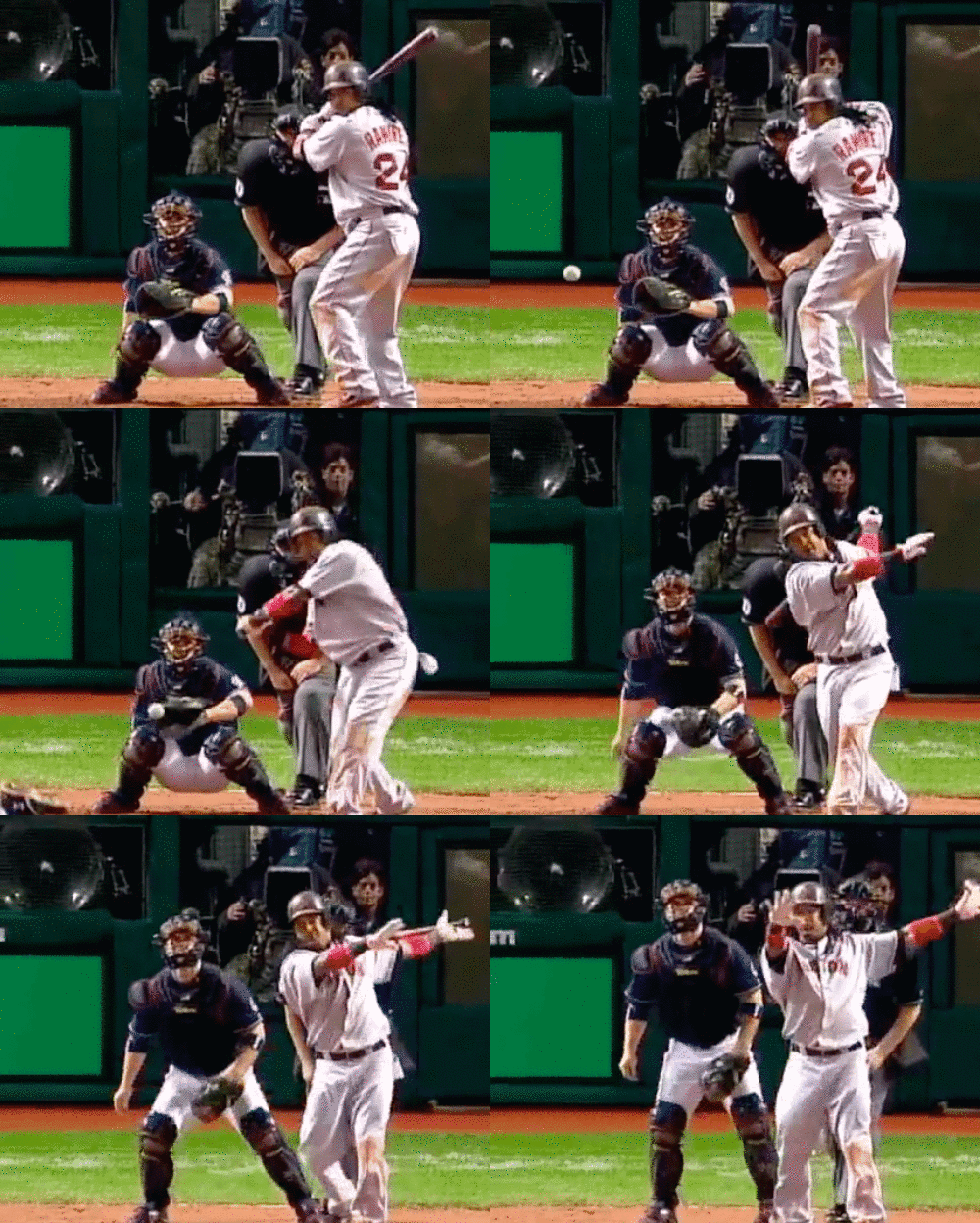
There is a time for mechanical thinking and movements during a game. The time is on deck and in between pitches of your ab. When the ball leaves the pitchers hand thats when you need to just see the ball and react. The ab above is borderline ridiculous with how much time they give Manny in between pitches of the ab but you can see him reinforcing his mechanical cues after every pitch. Now at the amateur level unless you swing you still have to stay in the box but you should have a routine that you go through between pitches.

As a younger coach I used to always tell my hitters to put your body on auto pilot during the game and just try to be the best player in the country at seeing the ball. I still think the #1 thing is seeing the ball well but you can't see the ball well until the pitcher lets go of it. Hitting is a craft that you never master but taking ownership of your swing creates a better feel and understanding of your swing. How many reps do we miss out on as hitters because we don't think about mechanics at all during games? The worst feeling as a hitter is failing and not knowing what's wrong. In the daily struggle to master mechanics you can't take game days off. You need to keep reminding your body of the proper muscle memory you want to enforce. You need to figure out what your mechanical and mental self talk key words are. What can you tell yourself during a game that will get you back into the present. You will only find this through  daily effort to be present and searching to understand how your body is moving. As a coach we can teach you about concepts and tell you what it looks like but we can never tell you how it feels, and we can't go up to home plate with you. That's why it all comes back to you taking ownership of the development of your swing. The more you can feel the movements the easier it is to make adjustments.

Below is a few gif's from Manny's ab. A few things to point out: Manny has a routine that he goes through on each pitch. Although you can't make yours as long as his it is clear that there is a mental process he is going through. Manny, like a lot of great hitters is big on the scalp load of his top arm and you can see him reminding himself of that movement throughout the ab. He goes through this same movement when he is in the cage. My favorite gif is the second one. Manny gets too far out front with his stride. He reminds himself to stay back and then reinforces that thought with practicing his load. A lot of Manny routine is to get himself prepared for the next pitch and it keeps him relaxed. What is your routine?


**Bonus gif**
The end result of the AB is a strike out looking. Manny's reaction is of indifference. He will be up again in two innings.


Friday, January 1, 2016

No Cage, No Problem

 For the amateur player it can be difficult to find a cage to hit in on a daily basis over winter break. However you can still make improvements on days you do not have access to a cage. Here are a few things you can do.

1. Take dry swings: you do not need a huge area to work on the mechanics in your swing. Even if you do not have enough room to actually swing you can work on your load to landing segment of your swing. Dry swings are great because you are taking the ball out of the equation and you can focus on feeling the right movements. A mirror is also a plus so you get immediate feedback but also try closing your eyes for a few of your reps it will allow you to focus on the movements you are trying to master.  Most of the movements that have mechanical deficiencies happen before actually swinging the bat so with the dry swing you can isolate and develop cleaner movements.

2. Study video of MLB players: watch big leaguers and see how they move to be successful. I suggest watching guys with similar body types to yourself. Try to mimic these players when you are experimenting in the cage. I can't emphasize enough the importance of watching guys who hit at the highest level. A big reason why big leaguers are the best hitters in the world is that they have developed great mechanics that fit their coordination level and body type.

3. Read articles and books on hitting. There are plenty out there and they will help develop your mental approach.

4. Go to the gym/ if you don't have a gym do some pushups, sit-ups, pull-ups. The stronger and more dynamic you get the easier hitting becomes. You can never be too strong

5. Study your own video. Make it a priority that every time you can hit in the cage you take some video of yourself. There is no better tool in improving your game. Keep the videos organized together so you can track your progress.

6. Keep a hitting notebook. Not many amateur players spend the time to write down their process with their swing. Your thought patterns when your swing feels good is important to remember when your swing goes through a rough patch. Just going back and reading through your notes can get you back on track. Also, keep track of what you are working on so that you can monitor your progress. One of the first pages in your notebook should be your goals for the 2016 season so you can remind and motivate yourself why you are putting the work in to improve.

-Take ownership of your swing. Find a way to improve. Every day you have a chance to get better in some way. The more you understand your swing and have the ability to critique and develop your own swing without your coaches feedback the quicker you will see results.

Thursday, December 31, 2015

Winter Break reading.

http://81769q5mqdpdt0bofpoi1n4z12.hop.clickbank.net/

If you haven't read Bobby's Ebook yet the link is above. One of the best ebooks I have read and I strongly suggest studying it. 

The Cage

One of the biggest things I see with amateur players especially in the northeast when they are inside in a cage for most if not all of the offseason is the hitter works on a swing that he doesn't use in the game. You have to create a routine for yourself in the cage. Obviously you want to start off the tee or with some swings with front flips at 50% percent. Then you should go to a round or two of bat control where you are working on the path of your swings and letting the ball get deep and going the other way. However, after you are loose you need to practice the swing you will take in the game. The video above is of a young Bryce Harper in 2009. He has made some mechanical adjustments to his swing since then but you can see the intent and focus in this cage session. He is also swinging hard like he would in the game. As a hitter you can trick yourself in the cage because if you hit a line drive on the barrel it looks great in the cage with a 60% swing and it is easier to be accurate. That's not the swing you are going to take in the game.
As a hitter you want fast twitch muscles and you need to train and develop those fast twitch muscles. You can only train those muscles if you are swinging at close to 100%. Find out how hard you can swing and still be accurate with the barrel. This varies between hitters based on coordination and body type. Some like Javier Baez or Josh Donaldson can swing at close to 100% where a guy like Adrian Gonzalez swings near 80%. Find your ideal swing effort and you can only find that if you allow your body to swing at 100% and then work down from there.
Remember that anyone can hit off the tee or front flips or bp and make contact on the barrel. You can separate yourself if you develop that ability to be accurate while also swinging close to as hard as you can. As you take ownership of your swing understand that your swing will evolve into a dynamic swing if you have good focus in the cage on each rep and you are determined to push the limit with the amount of bat speed you can create.
Here are a few points of emphasis as you experiment with this concept:
 1)be slower/earlier with your load so that your body has time to be dynamic during the load prior to landing.
2) Don't worry about the results of an individual rep. Don't be afraid to look bad in the cage as you experiment. You will never get a hit in the cage but you can become a great hitter in the cage. Evaluate your progress and focus, not the results
3) In the off season there is always something new to experiment with and fine tune. Be willing to experiment and work on different parts of your swing. You should never have a day in the off season where you are just taking mindless swings to "get your work in"
4)Swing hard and keep trying to be faster. You can never have too much bat speed.
5) Remember why you are in the cage: your goal should be to prepare to mash baseballs in the game. Kenny Powers has a ridiculous quote in Eastbound and Down when he said, "I play real sports, I'm not trying to be the best at exercising" The point relates to the topic today, "You want to rake in the game, you're not trying to be the best at hitting off the tee or taking flips or bp in the cage."
6) The test will be when you get around your teammates, the most discipline hitters create the same focus on getting better when they are in a small group as they do when they are at practice with the whole team. Your teammates opinion of your swing ability in the cage should be irrelevant to what you are working on. This is way easier to say then do but as I said above continue to remind yourself of your goals and what you are trying to accomplish in the games this spring and that will help you keep perspective and focus in your daily work.

Below is a few gifs of big leaguers working on the swing they want to take into the game during practice.


Monday, December 28, 2015

Presence and Confidence

My second year in pro ball, my manager told me that in any relationship there is a dominant person and a passive person. He compared it to two Bucks coming up to a Doe in the woods at the same time. 9 times out of 10 one Buck looks at the other and knows its his time to go. He related the story to baseball and said, "let the pitcher know who is dominant without saying a word" Hitters don't realize how important their body language, presence and confidence are to their success at the plate. Josh Donaldson just had an awesome quote the other day on twitter, "you can't pimp a home run if you can't pimp a strike out." I like to say, "when you fail act like you did it on purpose and when you succeed act like it was inevitable. Everyone talks about the importance of the mental game, but half of being mentally tough is just being able to act different then how you feel. There is no rule against acting like you are a stud. You don't have to say a word but act like you are the best player out on the field and everyone is at the game to watch you play. When a defender lays out and steals your hit, smile even chuckle to yourself and jog off the field like it wasn't a big deal. When you hit a huge RBI double to break a tie game in the 8th, just act like its whatever. Most hitters think they have way more control over the outcome then they actually do. Just remember that you try to see the ball well, try to have good timing and try to hit it on the barrel. Whatever happens after the ball hits the barrel is out of your control. A dominant players realizes that success and failure are just a part of the game. My dad always told me, "You're not a good as you think you are when you play good and your not even close to as bad as you think you are when you are playing bad" There is no rule against acting like you would act if you went 4-4 with 4 home runs the game before. A great quote from the book "mind gym" is, "act like the player you want to become until you become the player you act like" My favorite guy to watch in the big leagues when it comes to presence is Miguel Cabrera. One of my favorite at bats of all time is the home run he hit off Mariano Rivera. The full ab is above but I wanted to point out a few different things from the ab. The first GIF is the 0-2 pitch, its a good pitch but Miguel lays off and takes a peak out at Mariano to let him know he's not swinging at that. The second gif is the 1-2 pitch that is easy to lay off of but then watch Cabrera's reaction: just backs away like its no big deal. The third GIF is the home run. The 4th Gif is my favorite, Miguel Cabrera just jogs around the bases like its just another home run. I also love Mariano's reaction just smirks as if to say you got me this time, whatever. Then the last clip shows Cabrera just walking off the field after the home run but if I just showed you that last clip you would have no idea if he struck out or hit a home run. The way Miguel Cabrera acts is one of the reasons why he is one of the best hitters in the world.


I added two more great examples of expressing your dominance on the field without saying a word.


Saturday, December 26, 2015

Keep the Ball off the Ground

Hit hard line drives and fly balls. The opposite is taught at the high school and college level. "Put the ball in play" "Put pressure on the defense" "Just make contact" A weak ground ball is praised and a strike out is shunned. A lot of big league pitchers make a living as a pitch to contact, ground ball specialist. When you hit the ball on the ground  with a man on first it can turn into a double play. With a man on third and less then two outs a ball in the outfield alway works. At the high school and college level the best defenders usually play in the infield. Get the ball in the outfield. There are only 3 guys out there and way more room for balls to land safely. This mindset also creates good "swing path" and allows the hitter to let the ball travel more. (will go into the mechanical advantages of this mentality in the next post)  
In Ted Williams' book "the Science of Hitting" he says, "hit the ball hard and hit it in the air" He also talks about a slight uppercut swing as the ideal swing to match plane with a ball coming from an elevated mound. Kris Bryant, the National League rookie of the year made a similar quote, " “I liked hitting home runs when I was little,” Kris said. “To do that, you have to hit the ball in the air, so that’s why I caught on pretty quick to the idea of hit it high and hard. When I got to high school and college, where you begin learning about angles and stuff, it started to get easier. But I have always had that swing, in terms of a slight uppercut, so I guess I got it pretty young.” (I will talk about those angles in a future post)
In Kris Bryant's senior season at University of San Diego he hit 31 home runs; which was more than 221 Division 1 baseball teams hit for the entire 2013 season. Kris Bryant is 6'5'' but I believe height is irrelevant to power. Hank Aaron was 6 feet tall and Willie Mays was 5'11''. Power comes down to swing path, timing and seeing the ball well. Kris Bryant says, " I need to do what I need to do to be on time and see the ball as clearly as possible."   
My last few posts have been about getting to a lower position to swing from. Being in a lower sitting position at landing allows you to attack pitches with a slight uppercut because the swing does not have to be as steep to the slight upper cut as it would be from a higher landing position. In the two clips below focus on his shoulders. The back shoulder goes down to the height of the pitch. The first two clips are balls up in the zone and the back shoulder still goes down. The last clips the ball is lower which adds more down in the back shoulder to contact.  This movement creates a swing that has lift but doesn't make the swing long which is what many would say about the upper cut. Two final thoughts for today: 1) Work on this in the cage, once you are fully loose swing hard in the cage trying to hit hard high line drives. Most hitters never find out how hard they can swing and still be accurate with their barrel. 2) Even in the cage swing at balls you can hit on the barrel and drive to the outfield and lay off of pitches tossed/thrown to you that are above your belly button. Pitchers don't pitch above the top of the zone very often and when they do its by accident or a high waste fastball that should be a take. Pitchers try to throw both fastballs and off speed pitches down in the zone. Develop a swing where you can drive those pitches and also develop a swing that limits your ability to hit balls at your letters, its not a strike.  As hitters until we get two strikes our goal is to only swing at balls we can drive to the outfield. The pitches we lay off of are just as important as the pitches we swing at. There are a lot of pitches that we make contact on in a game that if you had just taken that pitch on the corner you might of got the next pitch in the middle of the plate to drive.  


Saturday, December 19, 2015

The Sitting Action


The biggest problem that effects hitters is not getting themselves in a good position to adjust to the baseball. Timing is a key part of hitting but we have to understand that it is very difficult to have perfect timing. The key thing to understand is that if you have great body movements you don't have to be on time to still be in a good position to hit. Most hitters are taught that you load back and then you stride forward and the adjustments that hitting coaches make if that doesn't work is to "get the foot down early" or not stride at all. Neither of which helps the hitter store energy. Hitters need to think about the early movement in the swing as their element of style and timing. Some guys are loud with their load others are simple depending on body type and coordination levels. However, the "load" is not back and the stride is not forward. You need to decide how you are going to gather or load but all you are doing in the gather is setting yourself up for the down or sit. In the clips below you can see how the hitters are bringing their hip line down. Watch their back hip joint as it moves down. The reason that the stride is taught as a forward move is because the body does move forward as the hips or butt sits down. As you sit down your body naturally needs a wider base to support that position. 

The main point of this post is to understand that you do not want to think of striding forward but instead sitting down or pushing your back hip down. The lower your start in your stance the less down there will be. Once we begin the sitting movement we just keep sitting down and track the ball and wait for it to get to us. Most hitters know that at contact the position of power is a bent back elbow however most amateur hitters get to contact with a straight back elbow. This is because most amateur hitters load back and stride forward so if they are not on time they have no way to adjust and have to reach out to hit the ball. (I put 3 pictures below of the right contact position)

This concept is difficult to put into words and I have done my best but here is an article that may help some understand it better: https://tewkshitting.com/josh-donaldson-swing-changes-over-time-and-adjusting-to-off-speed-pitches/
Watch Donaldsons' transformation as a hitter from college to pro ball and then look at how he adjusts to different pitches. I am going to stop there but continue to revisit this concept in future posts.