Tuesday, April 19, 2016

With Runners in scoring position TAKE YOUR STEAK when the pitcher executes w/heaters away


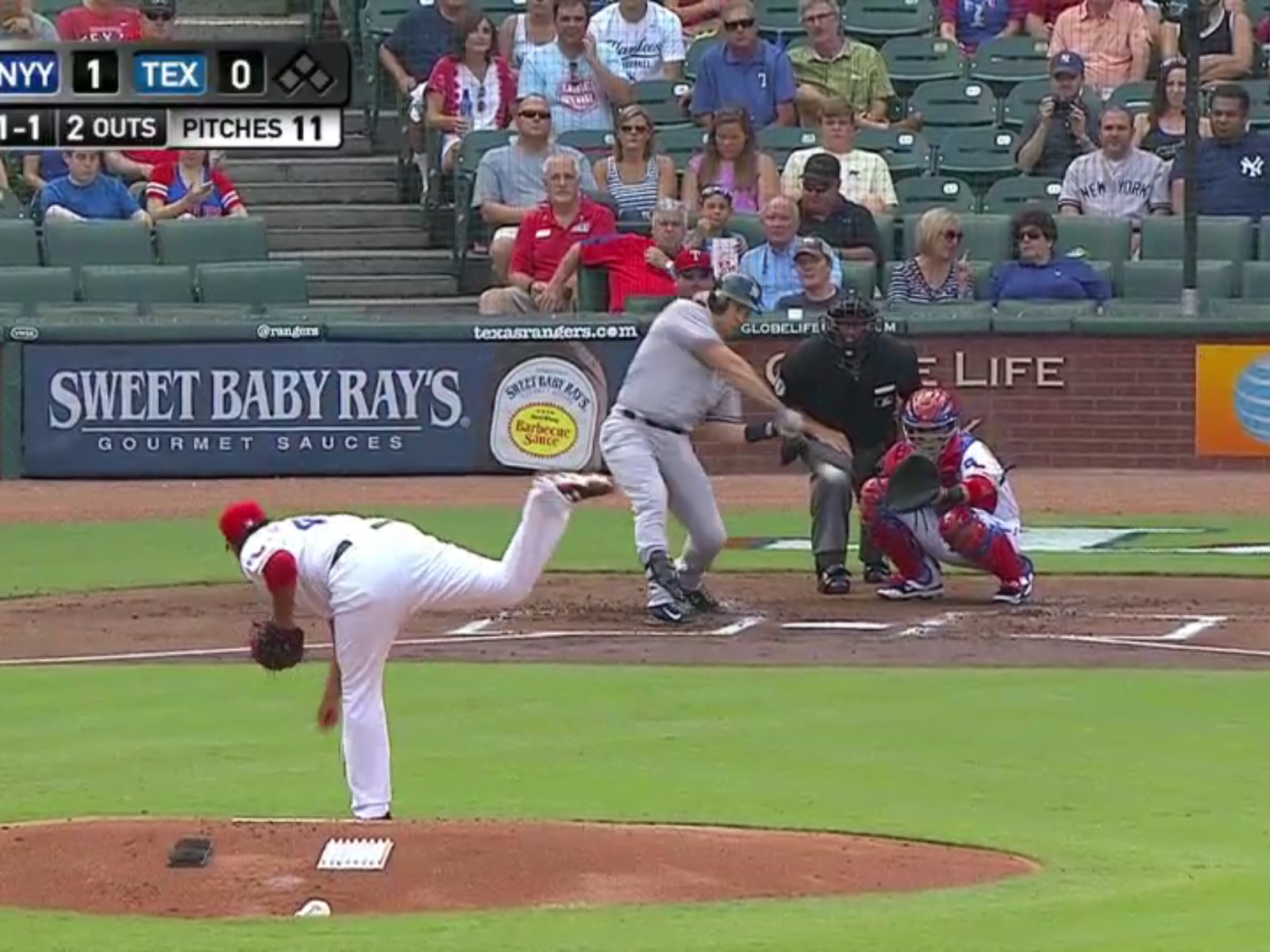
No one likes homers more than me but Steaks (RBI's) are the second most important stat to me and sometimes you need to recognize the situation and take what you know the pitcher is throwing you not necessarily what you want to hit. Remember each pitcher has comfort zones and like we talked about in the previous post away is a comfort zone for almost all pitchers. As hitters we want to take painted fastballs on the outside corner even when they are strikes until we get to 2 strikes. If a pitcher can paint all game on the outside corner then that pitcher will pitch in the big leagues. The reason you want to take the outside corner heaters is you can't do damage on it unless your name is Mike Trout, Miguel Cabrera, Josh Donaldson, and the handful of other top hitters on the planet. If you aren't in this fraternity of the greatest hitters in world then you can't consistently do damage on the ball on the outside corner, so stop trying to. The pitcher wants you to swing at it. I had a very short professional career some of which I was a starting pitcher. I stunk I threw 85 MPH cutters a bad curve ball and a really bad changeup and relied on the other team trying to hit homers off my mediocre arsenal. One team in particular always lit me up, I mean always, The Quebec Capitales. Their lineup was filled with smart hitters, who had consistent focus and approach. I would paint away and they just wouldn't swing. Drove me crazy and almost every time I missed my spot over the middle of the plate they swung. I was in great shape when I was a starting pitcher and actually led the whole league in complete games that year, but I never threw a cg against Quebec. I once threw 145 pitches in 7 innings of work against them. They never allowed me to have an easy inning. It was mentally/physically draining trying to compete against that disciplined of a lineup. They had one savage Sebastien Boucher who owned me. He never swung when I executed a pitch but when I missed location he killed it all season long and when I gave him nothing to hit he took his walk. In 2012 against me he was 4-6 with a double, triple, 2 homers, and 2 walks. Boucher was an injury away from making it to the big leagues facing a position player that was trying to extend his professional career by pitching. It would have been very easy for him to loose focus on me because I stunk and he was great. However, he was a true Professional Hitter and I never saw him give an AB away. Great hitters believe they can get a hit off anyone on the planet and also just as important they understand that any pitcher can get you out if you take him for granted and loose focus. That quick story brings me to the main point of this post. With runners in scoring position and 2 strikes or with 1 strike off a pitcher that has a great out pitch, if the pitcher has shown you that he is comfortable throwing the ball on the outside corner look out there and just get the barrel on the ball with a 75% effort swing and take your knock through the opposite field infield hole (LHH/6HOLE, RHH/4HOLE) Once you master this the advanced step is to be able to adjust to a mistake off speed pitch in this situation and drive the hanging off speed pitch even with 2 strikes. You have time to do this if you see the ball well out of the pitchers hand and don't give up on the pitch just because it is not the heater away you were looking for. With this approach your one hole is if the pitcher comes hard in on the black. If that happens just try to emergency swing and foul it off but if he freezes you and you strike out just tip your cap to the pitcher and adjust your approach for the next AB. Below is two big leaguers taking their knock with 2 strikes on heaters off the plate away that they took "ugly" mechanical swings on but found a way to get their barrel on the ball and took their steaks through the opposite field hole. 


Wednesday, April 13, 2016

Hanging Breaking Balls. Hit them Early!

I've heard over and over hitting coaches tell their players to hunt the fastball and lay off the curve ball. However, good pitchers are good because they can locate their fast ball consistently. Especially with the college and high school pitcher they will try to throw their fastball down and away. They will not execute every time but that is their comfort zone. Some will also come in off the plate. This pitch is effective because hitters are taught to look away and react in so they don't have time to react to a pitch in when they are looking away. However, the point of this post is to talk about off speed pitches. To reiterate good pitcher are comfortable throwing their fastball down and away. That's not a pitch you want to hit as a hitter. However, the other comfort pitch for pitchers is the breaking ball (most pitchers) and every once in a while the change up (amateur pitchers don't have a feel for this pitch for the most part). Early in games the starting pitcher has the luxury to throw their off speed pitch of choice in the middle of the plate and hitters are encouraged to take it!!! As the game goes along the pitcher will get a better feel for his off speed pitch and the pitch will get better. The pitch to hit early in the game is not the fastball its the off speed pitch. Hitters should look for it! It is taboo in most hitting philosophies to look for off speed because taking a fastball in the middle of the plate is a cardinal sign. why? I encourage you to sit on off speed pitches early in games. Especially 0-0 (even more with runners in scoring position) and 0-1 after a fastball strike. Set your timing up knowing a slower pitch is coming and know its coming until the ball shows you its not that pitch. The key to hitting the get me over off speed pitch is you want it to end up above the knees and you want to let it travel. You also want to match the plane of the incoming especially breaking ball with an uppercut swing. Have you ever done a curve ball round during batting practice or hit curveballs of a pitching machine during practice. It's not that hard to crush those breaking balls when they are in the zone. WHY? Because you know its coming! Well in the game look for it in certain counts and situations and you can crush it. Because of the spin of a breaking ball if you match plane with your body and bat path the ball goes a long way when you hit it on the barrel. Watch the big league hitters. You can tell even when they don't hit the off speed pitch well that they were looking for it on certain pitches. Hitting approach is something that needs to be talked about more. Start with this simple adjustment and watch how many hanging breaking balls you get to hit especially early in the game off the starting pitcher. One thing Josh Donaldson does with his approach is when he has decided to take prior to a pitch he will take as long as the pitcher doesn't throw him a get me over curveball if they do even when he has decided to take he will swing at it and he hit 6 homeruns last year on hanging breaking balls that he had pre-determined as a take pitch. It works! Try it. Below are all still pictures of big league hitters hitting home runs on off speed pitches. Notice how they set their body up to match plane with the pitch. Big league hitters hit homeruns on off speed pitches every night. They hunt them in certain counts based on pitchers patterns. In the next post we will talk about how you can still hit homeruns on off speed pitches even when you are looking fastball if you set your body up right to adjust to the change in speed and trajectory of the off speed pitch compared to the fastball.


Thursday, April 7, 2016

The Shoulders. Track with the front get on plane with the back.


As a hitter your front shoulder is your scope. You should try to line it up at release point like the scope on a riffle. Many hitters over rotate their front shoulder forcing themselves to commit to swinging earlier. A reminder that the biggest thing a hitter can create for himself is time and when you have to commit to swinging early the baseball is not close enough to read if it is a good pitch to hit so you really are just guessing. You want to keep your front shoulder tracking the ball as long as possible. When you eyes tell you its time to swing, instead of "throwing your hands at the ball what you want to do is bring your back shoulder down to the height of the ball. This allows you to "get on plane" or "swing level" You do not want to swing down at the ball. Coaches teach this because they think swinging down is the shortest distance but all they are doing is forcing their hitters to have perfect timing to make solid contact. Here are some still pictures from homeruns last night. Notice how they line up their front shoulder with the ball and then take their back shoulder down to the height of the ball. The shoulder angle is more steep when the ball is down compared to a more elevated location. More to come soon.


Wednesday, March 30, 2016

Look away and React In Ruins Careers

"Look for something that you have the most time on and react to the thing you have the least amount of time on" The trainer tells his boxer, "Look for the knock out punch but react to the JAB" The teacher says, "rush through the hard questions and take your time on the easy ones." I think you get my point. I'm not sure when or how but in baseball it has become taboo to teach a kid to pull. Going the other way has become the holy grail like you get two hits if you hit a single to the opposite field. Everyone says, "stay inside the ball" even though I still have no clue what that actually means. I honestly feel like pitching coaches have disguised themselves as hitting coaches to make hitters easier to get out. My college coach used to have the last round of bp be an opposite field line drive stick round which even as a 21 year old kid I knew was wrong, like my line drive (as a LHH) to right doesn't count and also it guarantees that my last swing in bp is a bad one. I really like a feel good round to end bp. Once you hit a ball on the barrel get out so you can always end on a quality swing. Coaches are teaching kids to try to hit the ball to the opposite field and I don't know why. Good hitters hit the ball to the opposite field when they are late the right way or taking their knock on the ground through the hole. The worst part about this universal fetish for hitting the ball the other way is it is messing up kids mechanics. The majority of young guys I coach step closed because youth coaches tell kids to look away and react in. I am going to do at least 2 more posts on this topic with video so I am being very vague right now. However, for now I want to address two "fatal flaws" that more guys should try to do. 1. STEP IN THE BUCKET! 2. UPPERCUTS ARE GOOD! Pitching and hitting are very similar with the lower half but in hitting someone said you are suppose to land with a square/ closed front foot. Whoever came up with that must of been a pitcher. Tomorrow and the next day I will get into this more with video proof but this is good for an introduction. I will finish with the simple statement. Whatever your hitting philosophy is make sure that the big leaguers do it too. The biggest misconception I hear over and over is that amateur hitting coaches say, "that's big leaguers.... you can't teach a kid to do that" MLB hitters have to hit the best pitching in the world so their mechanics will work in the amateur world. Coaches are just not willing to teach it. Baseball is the only major sport where hitters look more like little leaguers mechanically then big leagers. This is because most hitters spend their whole career trying to prefect the first swing that was taught to them. The best players in the world are always looking to find a new mechanical edge, are you?


Tuesday, January 5, 2016

Slow and Early

The video above is old now but the same message still applies. I came back to this video because I was thinking about a player on my team last year named Billy Derosier who really worked hard on the mechanics of his swing and his numbers showed that work last spring (340ave, 11 2B, 11HR compared to 316 6 2B 0HR in 2014) He is only one of a few players I have ever coached that started to move like a big league hitter. The biggest thing for him last off season was he started working on beginning the load slower and earlier. Although there were a lot of awkward movements early on in his process, he stuck with it and by the time we started playing our schedule I knew he was going to have a good year just by watching him take pitches when we were going live. When you start slow and early you realize how much time you can create for yourself. Your body has a chance to move and store energy that you can use in the swing.  Guys that start early are swinging until they aren't. Most amateur hitters load, try to recognize if its a strike and then make the decision to swing. I made a youtube video below of Billy's progression during pre season practice last year. The video starts with the earliest video I had of him and goes until a few days before we played our first game. You can see that he works through the awkwardness of the time he created for himself and by the end of pre-season camp he had the ability to adjust to the tempo of each pitcher and create some serious bat speed to hit with during the load process of swing.
Another guy I saw an adjustment to moving earlier is AJ Pollock, the center fielder for the Diamondbacks. The swing on the left is from last year, the swing on the right is from 2 years ago. He went from hitting 302 with 19 doubles and 7 home runs to 315 with 39 doubles and 20 home runs.
The best hitters in the world experiment and make adjustments to their swing to become better hitters and I see a ton of amateur hitters that are resistant to change. Most amateur hitters are just trying to get better at the first swing that was comfortable to them. I can't emphasize enough the importance of experimenting with how you move in the box to prepare to hit. The first part of this process is working on starting to move earlier then what is comfortable to you now. You can always start later but if you have the ability to begin storing energy earlier it will impact how much bat speed you have as you swing the bat.

A few other big leaguers that changed their swings from one season to another: JD Martinez went from getting released from the Astros to having a great year for the Tigers. Donaldson went from a good big leaguer to the MVP. Are your swing mechanics allowing you to be as great as you want to be?


Sunday, January 3, 2016

What is your Routine?

There is a time for mechanical thinking and movements during a game. The time is on deck and in between pitches of your ab. When the ball leaves the pitchers hand thats when you need to just see the ball and react. The ab above is borderline ridiculous with how much time they give Manny in between pitches of the ab but you can see him reinforcing his mechanical cues after every pitch. Now at the amateur level unless you swing you still have to stay in the box but you should have a routine that you go through between pitches.

As a younger coach I used to always tell my hitters to put your body on auto pilot during the game and just try to be the best player in the country at seeing the ball. I still think the #1 thing is seeing the ball well but you can't see the ball well until the pitcher lets go of it. Hitting is a craft that you never master but taking ownership of your swing creates a better feel and understanding of your swing. How many reps do we miss out on as hitters because we don't think about mechanics at all during games? The worst feeling as a hitter is failing and not knowing what's wrong. In the daily struggle to master mechanics you can't take game days off. You need to keep reminding your body of the proper muscle memory you want to enforce. You need to figure out what your mechanical and mental self talk key words are. What can you tell yourself during a game that will get you back into the present. You will only find this through  daily effort to be present and searching to understand how your body is moving. As a coach we can teach you about concepts and tell you what it looks like but we can never tell you how it feels, and we can't go up to home plate with you. That's why it all comes back to you taking ownership of the development of your swing. The more you can feel the movements the easier it is to make adjustments.

Below is a few gif's from Manny's ab. A few things to point out: Manny has a routine that he goes through on each pitch. Although you can't make yours as long as his it is clear that there is a mental process he is going through. Manny, like a lot of great hitters is big on the scalp load of his top arm and you can see him reminding himself of that movement throughout the ab. He goes through this same movement when he is in the cage. My favorite gif is the second one. Manny gets too far out front with his stride. He reminds himself to stay back and then reinforces that thought with practicing his load. A lot of Manny routine is to get himself prepared for the next pitch and it keeps him relaxed. What is your routine?


**Bonus gif**
The end result of the AB is a strike out looking. Manny's reaction is of indifference. He will be up again in two innings.


Friday, January 1, 2016

No Cage, No Problem

 For the amateur player it can be difficult to find a cage to hit in on a daily basis over winter break. However you can still make improvements on days you do not have access to a cage. Here are a few things you can do.

1. Take dry swings: you do not need a huge area to work on the mechanics in your swing. Even if you do not have enough room to actually swing you can work on your load to landing segment of your swing. Dry swings are great because you are taking the ball out of the equation and you can focus on feeling the right movements. A mirror is also a plus so you get immediate feedback but also try closing your eyes for a few of your reps it will allow you to focus on the movements you are trying to master.  Most of the movements that have mechanical deficiencies happen before actually swinging the bat so with the dry swing you can isolate and develop cleaner movements.

2. Study video of MLB players: watch big leaguers and see how they move to be successful. I suggest watching guys with similar body types to yourself. Try to mimic these players when you are experimenting in the cage. I can't emphasize enough the importance of watching guys who hit at the highest level. A big reason why big leaguers are the best hitters in the world is that they have developed great mechanics that fit their coordination level and body type.

3. Read articles and books on hitting. There are plenty out there and they will help develop your mental approach.

4. Go to the gym/ if you don't have a gym do some pushups, sit-ups, pull-ups. The stronger and more dynamic you get the easier hitting becomes. You can never be too strong

5. Study your own video. Make it a priority that every time you can hit in the cage you take some video of yourself. There is no better tool in improving your game. Keep the videos organized together so you can track your progress.

6. Keep a hitting notebook. Not many amateur players spend the time to write down their process with their swing. Your thought patterns when your swing feels good is important to remember when your swing goes through a rough patch. Just going back and reading through your notes can get you back on track. Also, keep track of what you are working on so that you can monitor your progress. One of the first pages in your notebook should be your goals for the 2016 season so you can remind and motivate yourself why you are putting the work in to improve.

-Take ownership of your swing. Find a way to improve. Every day you have a chance to get better in some way. The more you understand your swing and have the ability to critique and develop your own swing without your coaches feedback the quicker you will see results.